
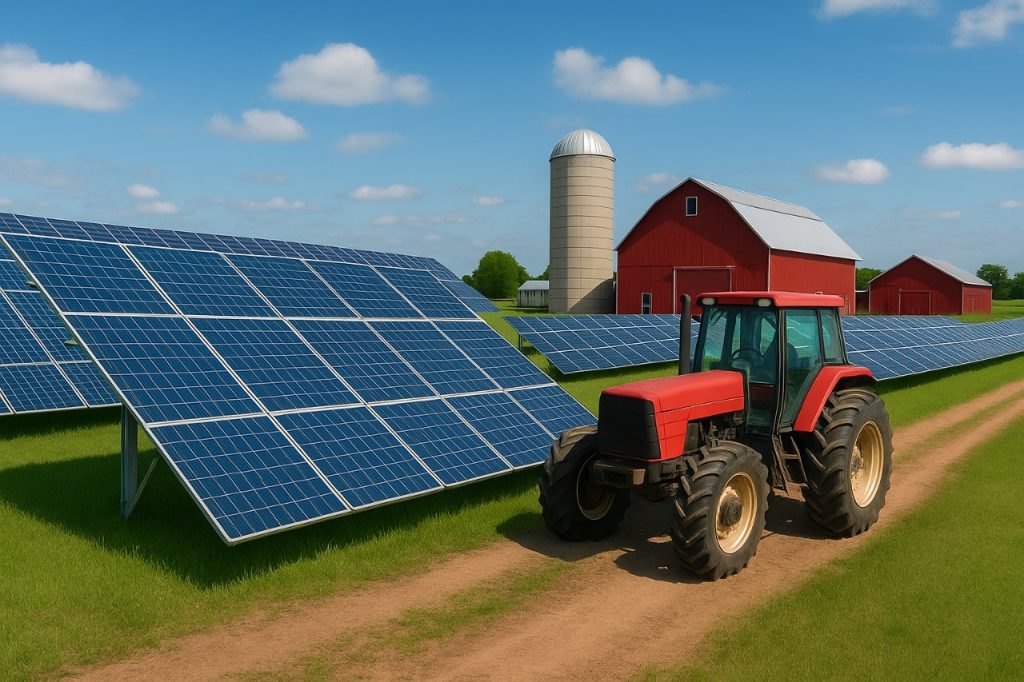
Agriculture is one of the major contributors to the national Gross Domestic Product (GDP) in Nepal. According to an economy survey of Nepal 2020, agriculture contributes 25.8% of the total GDP, employing nearly 65% of the total population in Nepal. Solar energy has been integrated with agricultural practices since ancient times, particularly for cultivation, crop production, and biomass drying. A significant reduction in the manufacturing cost of solar cells has lowered the investment capital required for PV system installations compared to other energy sources such as wind, hydropower, and nuclear energy.
Nepal has high potential for agrivoltaics with over 300 sunny days per year and high solar radiation. The solar power generation can be effectively combined with crop cultivation. Limited availability of flat land for both farming and energy projects makes dual land use through agrivoltaic especially beneficial for the context of Nepal. It can also help to reduce water evaporation and protect crops from extreme weather, which is increasingly important under changing climate conditions. Therefore, agrivoltaic systems offer a sustainable solution for Nepal’s energy security and agricultural resilience.
Agrivoltaic systems are designed in different forms to balance electricity generation with agricultural productivity. Ground-mounted systems are the most widely adopted concept, where panels are tilted and installed at an elevated height to allow crop growth and solar power generation, while also reducing soil evaporation and protecting plants from extreme weather. Vertical bifacial systems consist of solar modules mounted vertically, often in a north-south alignment, which capture sunlight on both sides and are effective in regions with reflective surfaces such as snow or sand. They allow easy passage of farm machinery and cause minimal shading on crops, making them suitable for row-based cultivation. Single-axis trackers rotate panels from east to west during the day, while dual-axis trackers move in two directions to follow the sun more precisely, significantly increasing energy yield. These tracking systems can also be programmed to provide alternating shading patterns that enhance plant growth and soil moisture retention.
Similarly, overhead agrivoltaic systems place solar panels several meters above the ground like a canopy, which is particularly beneficial for orchards, vineyards, and livestock grazing. By providing partial shading, they protect crops from heat stress, hail, and excessive sunlight while allowing enough radiation for growth. However, they require higher installation costs and stronger structural design. Semi-transparent systems, on the other hand, use specially designed panels that allow a portion of sunlight to pass through to crops. These are often integrated into greenhouses, creating a dual benefit of controlled agricultural conditions and solar electricity generation. Semi-transparent panels are especially suitable for leafy vegetables and plants that thrive under diffused light. Each system is chosen based on crop type, land characteristics, and energy requirements. Together, these agrivoltaic designs demonstrate the versatility of solar integration in agriculture and highlight the potential for sustainable food and energy production.
The integration of solar energy, particularly through agrivoltaic systems, requires high investment capital and adequate land for installation. In Nepal, however, most farmers face challenges such as land fragmentation, limited land availability, inadequate infrastructure, and restricted access to modern technology and markets. With strong government support through effective policy interventions and subsidy mechanisms, agrivoltaics could become a smart solution for Nepal. This approach would allow farmers to grow crops and generate clean energy on the same land, saving space, protecting crops, and contributing to a more sustainable future.